
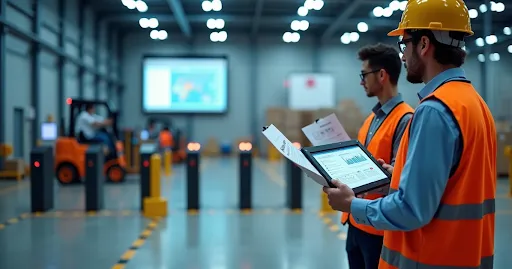
In the industrial context, internal auditing takes on a strategic role, acting as an instrument that drives improvement, protects assets and ensures compliance amid complex operations.
In large industrial warehouses, where workers, contractors, visitors and vehicles circulate at all hours, the challenges of ensuring access control, document management and physical security multiply.
That is why adopting a structured verification process, from planning through to implementing improvements, is essential for identifying weaknesses, correcting deviations and protecting the operation from unnecessary risk.
This article answers the main questions about how to organize and carry out verification in large industrial warehouses, from the initial stages to closing, with a practical focus grounded in reality!
Where does the audit process begin?
The starting point should be understanding the objectives: what is the focus of the verification? Physical security, the document compliance of third parties, access control, or all of those together?
Defining the scope well allows you to direct resources, establish indicators and choose the right tools. Clarity of objectives keeps the process from becoming a pile of tasks with no purpose.
Engineers, operational managers and the compliance area usually align those expectations, holding preliminary meetings and exchanging information about the biggest risks found in previous audits.
Another initial step involves mapping the warehouse flows: who enters, who leaves, where people, vehicles and visitors move. That data helps compose checklists and guides where the most important checkpoints should be.
How do you create a realistic schedule?
The schedule is defined taking the operation's routine into account. In large warehouses, movement is constant and it is not always possible to stop a section or block access. Ideally you arrange times when the team can move around without disrupting critical tasks or loading and unloading operations.
- Plan a route through the space, prioritizing areas of greater risk or with a history of occurrences.
- Reserve specific periods for interviews with those responsible for departments, such as logistics, asset protection and human resources.
- Distribute tasks among team members so each looks in detail at different items (physical access, documentation, asset protection, and so on).
Experience shows that the better designed the schedule, the greater the internal team's acceptance during the procedures. Adjustments are usually necessary, particularly in large operations, so flexibility is a necessary characteristic of this stage.
Checklists: the secret of good execution
Using specific checklists turns verification into a transparent, traceable process. Those lists should not be generic.
They should meet the reality of the industrial warehouse, covering the particularities of access control, third-party management and the documentation required by labor legislation and workplace safety standards.
- Verification of entry and exit records for employees, visitors and vehicles.
- Checking the mandatory documentation of contractors and their workers.
- Checking of electronic monitoring systems, alarms and image records.
- Inspection of circulation routes and critical points, such as access to restricted areas.
- Verification of team training on safety and evacuation procedures.
Keeping detailed records of the audit, with photos, digital files and objective reports, helps ensure traceability of actions for future analysis.
The importance of integration with internal systems
In large warehouses, different departments usually adopt varied systems for managing personnel, contracts, access and security. Integrating those systems is one of the most effective ways of ensuring the data collected during verification reflects reality, with less human interference and increased reliability of the information.
For example, by integrating electronic access control with third-party registrations, you avoid the entry of people without documentation or training. Beyond that, cross-referenced reports reveal inconsistencies and serve as support for decision-making during the audit.
Automation engineers frequently point out that integration reduces manual failures and speeds up the detection of anomalies, bringing a more reliable and immediate view of the environment being audited.
How do you identify vulnerabilities and act in time?
During the process, identifying vulnerabilities is one of the team's central functions. Gaps can occur both in processes (lack of document updates, access granted outside the standard, breaches of internal rules) and in equipment (an inoperative alarm, cameras without adequate coverage, blocked evacuation routes).
To map the weaknesses, the team should observe at least:
- Doors, windows and gates, testing locks and automatic devices.
- Access records, looking for inconsistencies in times or unknown users.
- Third-party entry procedures, with validation of documentation and anti-fraud requirements.
- Blind spots in the surveillance area.
- Deviations from standard safety processes, frequently identified through interviews and on-site observation.
Involving multidisciplinary teams
Large industrial warehouses can only maintain the standard of security and compliance when several departments work in alignment. That ranges from asset protection through to HR, transport, legal, IT and operations.
During audits, professionals with different backgrounds and experience contribute distinct views, which increases the chance of detecting risks and opportunities a purely technical team might not notice.
Team integration happens through preliminary meetings, clear definition of responsibilities and fast communication throughout the process. Experience has shown that involving workers from different areas makes the result more complete and the solutions better grounded.
How do you ensure third parties' document compliance?
In industrial operations, control over third-party documentation is always a sensitive point. Validation includes proof of mandatory courses, certificates of labor and tax good standing, contracts in force, lists of qualified workers and other obligations that vary according to legislation.
Leaving that responsibility with the gatehouse or procurement department alone can be a mistake. The process should be automated where possible and monitored by different areas, with all documentation collected in online systems, allowing real-time tracking.
Beyond that, document verification should happen not only at the start of the contract but periodically, so as not to run the risk of expired documents or unqualified workers in the environment.
Implementing improvements and following up
At the end of the process, an objective report structuring points of attention, recommendations and deadlines guides the next stages. Some decisions demand fast responses, such as blocking access or updating registrations.
Others call for medium-term projects, such as revising flows or contracting additional technology. The secret lies in establishing an owner for each action, tracking the deadlines and periodically reviewing the effectiveness of the measures taken, closing the improvement cycle.
In short, internal auditing in large industrial warehouses requires planning, multidisciplinary organization, objective controls and integration between physical and digital processes.
Adopting those practices protects assets, reduces risk and meets legal and contractual compliance requirements. Strengthening control over access, documentation and internal processes results in a safer environment for everyone.
Share this post on social media!
Frequently asked questions about internal auditing in industrial warehouses
What is internal auditing in an industrial warehouse?
Internal auditing in an industrial warehouse is a structured process of verifying procedures, controls, legal compliance and safety routines in industrial environments. Its purpose is to identify failures, propose improvements and ensure operations comply with standards and contracts in force.
How do you start an audit in a large warehouse?
It starts with a clear definition of objectives, analysis of the flows of people and vehicles, building the schedule and drawing up specific lists that take the complexity of the space into account. Meetings with department heads help structure the scope and guide the priorities of the checks.
Which documents do I need in an internal audit?
Verification usually requires access to access control records, lists of workers and visitors, contracts with contractors, training certificates, certifications for the applicable regulatory standards, proof of tax and labor good standing and an inventory of safety equipment.
Who can audit industrial warehouses?
Professionals from security, compliance, human resources, engineering and operations, often in multidisciplinary teams, are able to conduct audits in industrial warehouses. Companies can form internal teams or rely on specialist consultants, depending on their needs.
How often should I audit industrial warehouses?
The frequency varies with size, the criticality of the operations and the requirements of clients and certification bodies. The recommendation is to schedule audits at least annually, with additional reviews after relevant changes or incident occurrences.