
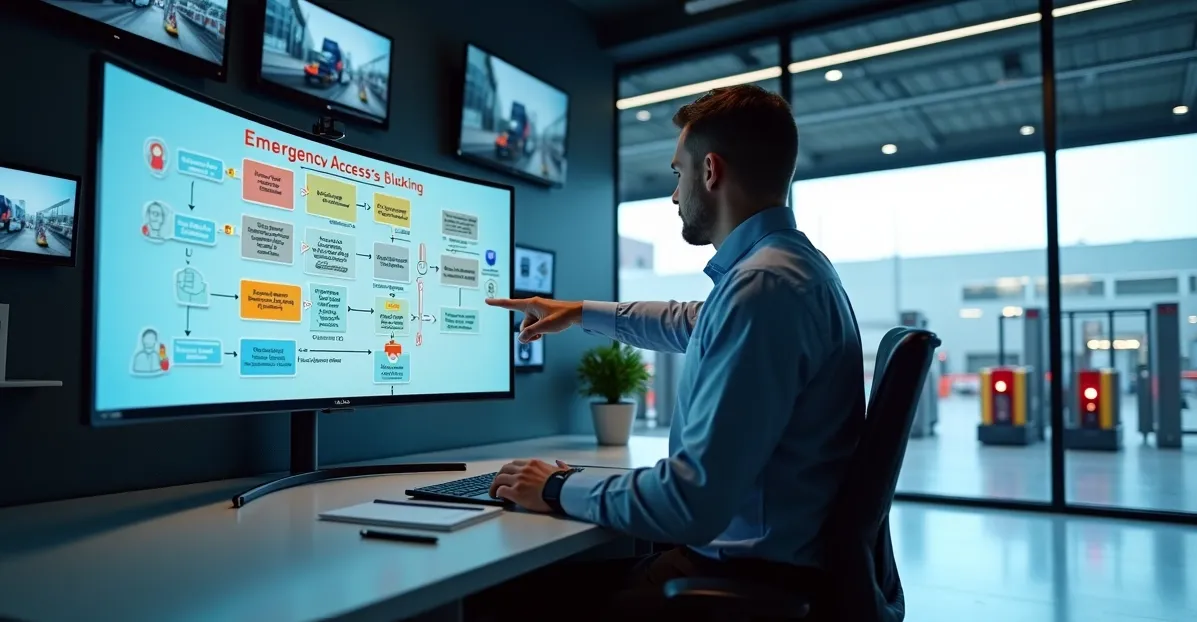
Automatic workflows for emergency lockdown have gained prominence in industrial and logistics environments because of the risks that out-of-standard situations can bring to the operation, to workers, to physical safety and to regulatory compliance.
Imagine a situation in which a service provider has expired documentation and still tries to enter a restricted area. If it depended on manual processes, the error could go unnoticed.
Read on to learn more!
Why are automatic flows decisive in industrial environments?
Industrial and logistics operations deal daily with hundreds or thousands of people, visitors, contractors and vehicles. The challenge is to ensure that only authorized people with valid documentation move through sensitive areas, and that at the first sign of irregularity or risk, immediate decisions are taken.
Automatic flows drastically cut the time between identifying the problem and acting on it. That applies to blocking physical access, suspending authorizations and triggering alerts to everyone involved.
These digital flows eliminate manual steps, which are prone to delay and human error, and protect lives, assets and the company's reputation. Emergency lockdown comes to be seen not as punishment but as a fast response to proven risk.
When is emergency lockdown really necessary?
There are several situations in which immediate lockdown becomes essential to protect people, information and assets. Some real examples of scenarios that demand an automated, fast response:
- Detection of an expired labor document or contract for a service provider;
- A worker trying to enter a hazardous area without valid training or without proper personal protective equipment;
- A visitor trying to enter restricted locations without pre-registration or authorization;
- Excess people or vehicles beyond the occupancy limit of a specific area;
- An emergency alert (such as a leak, fire or contamination) that demands instant evacuation and blocking of new entries.
In all these cases, knowing the problem exists is not enough, you have to act within seconds to keep the situation from escalating. A well-established digital flow can make all the difference.
Which stages make up a safe emergency lockdown flow?
To build a reliable, safe flow, the recommendation is to design clear, documented and auditable stages. Mature organizations segment their automations around the following phases:
- Risk detection: systems continuously monitor data on employees, contractors, visitors and vehicles, cross-referencing information in real time. A simple document expiry or excess of people generates an alert trigger.
- Document validation: artificial intelligence can be used to identify invalid, expired or fraudulent documents, minimizing dependence on manual checking.
- Immediate notification: everyone involved receives automatic alerts, managers, security teams and, where appropriate, the affected user or outsourced company. Transparency and speed are essential for a coordinated response.
- Automatic lockdown: integration with turnstiles, barriers, gates or digital systems immediately suspends access authorizations. No human action is needed at that moment, which raises the security of the process.
- Record and audit: the whole process is saved to a database, allowing future reviews, compliance reports and learning from past occurrences.
As you can see, the secret of the flow lies in clear criteria (who may or may not enter), in the speed of the lockdown and in fast communication.
How to structure a genuinely safe workflow?
Designing the flow calls for attention to technical and organizational detail. To be safe, the process must consider every point at which risks can be detected or accidentally let through.
Here are some important guidelines:
- Advance mapping of every type of access and sensitive area;
- Full digitization of the registration and validation stages, reducing paper and parallel controls;
- Standardization of lockdown situations, to remove any doubt about when to act;
- Clear definition of owners, triggers and alert channels;
- Automation integrated with physical devices (turnstiles, gates and readers) and digital ones (internal systems), to make sure there are no holes in the process;
- Periodic testing and constant review to avoid failures or operational gaps.
By following these guidelines, the company strengthens its culture of prevention and ensures automatic responses, with no vulnerabilities or delays.
Practical benefits for security and compliance
Implementing automatic flows reduces risks such as document fraud, fines for breaching labor standards, intrusions, accidents and even insurance costs. In external audits, you can prove the lockdowns were triggered correctly, demonstrating care for legal integrity and for everyone's well-being.
Beyond that, digital processes increase the confidence of clients and of the internal team, promoting greater transparency and control at every stage of the operation.
In today's environment, creating automatic workflows for emergency lockdown is not just a matter of convenience but of legal, physical and operational security. By structuring clear stages, integrating devices and digitizing controls, the company builds fast, safe responses, reinforcing a culture of prevention and responsibility.
If this content was useful, share this article on social media and help more companies understand the importance of automatic flows for safe emergency lockdown!
Frequently asked questions about emergency lockdown workflows
What are emergency lockdown workflows?
Emergency lockdown workflows are automatic decision flows that monitor risk situations and, on identifying an irregularity, block physical or digital access in real time. They involve stages of detection, validation, notification and immediate action, protecting the company's people and assets.
How do you create automatic, safe workflows?
The secret is to map every sensitive area and risk point, digitize document checking, integrate alert systems with physical access control and define objective criteria for lockdowns. Frequent reviews, automations based on clear rules and testing ensure the flow is reliable and transparent.
What are the benefits of automatic workflows?
They drastically reduce response time in the face of risk, eliminate human error and help avoid fines, accidents, intrusions and legal problems. They also make auditing easy and improve transparency between internal teams and external parties.
Is it safe to automate emergency lockdowns?
Yes, as long as the flow is well structured and integrated with reliable systems. Automation reduces the chance of human error and ensures proportionate, fast responses, contributing to the integrity of the environment and of people.
Which tools help create safe workflows?
The main resources include digital platforms for people and access management, artificial intelligence for document validation, APIs that link different systems and devices, plus automatic alert channels. The secret lies in integrated solutions adapted to the reality of the business.