
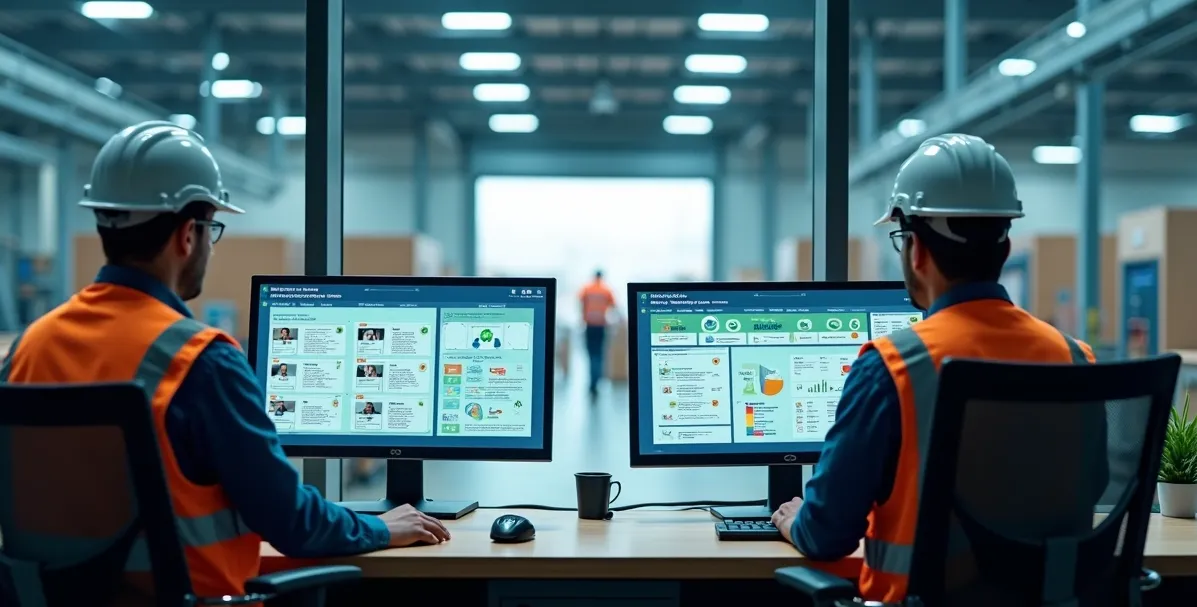
AI monitoring is changing the way companies handle security, third-party management and compliance in industrial, logistics and corporate environments.
Smaller organizations used to depend heavily on manual processes and scattered controls, which made efficient protection and rigorous document control difficult. Now even small teams can benefit from artificial intelligence to automate analysis, extend access control and make sure every record is up to date.
This advance does not just mean more convenience day to day. It reduces legal and operational risk, avoiding human error and helping companies react quickly to unexpected situations.
Small teams therefore gain more time to focus on what matters, keeping operations secure and aligned with the law.
Find out how small teams can transform large operations with intelligent use of AI in management!
Why does AI make such a difference in lean operations?
At companies dealing with intense movement of contractors, service providers, visitors and vehicles, the challenge is doubled: doing a lot with little. Monitoring with artificial intelligence emerges as an ally because it:
- Automates tasks that used to be entirely manual;
- Reduces errors in document checking;
- Sends instant alerts about risks or irregular situations;
- Allows clear views of who is entering the facilities and under what conditions.
Why does document validation matter for small teams?
Keeping the records of contractors, employees and visitors current demands time and attention. Without technology, the risk of admitting someone with expired documentation or incomplete information rises, exposing the company to fines and other legal problems.
In that scenario, artificial intelligence for document checking and validation is a genuine turning point. It can, for example:
- Analyze hundreds of documents in seconds;
- Identify whether an ID card, driver's license or contract is expired or contains inconsistencies;
- Automatically approve valid documents, reducing rework;
- Notify experienced staff only in genuinely doubtful cases.
A common example is the document flow for a large construction site, where contractors have to present certificates and attestations regularly. The AI analyzes each file, cross-referencing data and flagging outstanding items, without anyone on the team having to open document after document.
Automation in risk analysis and alert generation
Automation transforms teams' routines by taking care of tasks such as:
- Checking proof of tax good standing for outsourced companies;
- Monitoring expiry dates and ensuring records are constantly updated;
- Detecting access attempts by people or vehicles that are in default or irregular;
- Issuing real-time alerts to those responsible whenever there is any nonconformity.
In logistics operations, for example, on identifying a vehicle with outstanding documentation, the system can block access automatically and alert the manager instantly. That prevents risk situations without needing everyone on the team involved all the time.
Behavior and security: insights generated by AI
Beyond controlling who comes in or goes out, artificial intelligence solutions make it possible to analyze the behavior patterns of contractors and visitors. That information reveals trends in the environment and helps predict potential threats or lapses.
Among the possible insights, the following stand out:
- Identifying times and days with atypical access volume;
- Assessing how long suppliers and visitors stay;
- Detecting recurring attempts at irregular access or access outside permitted hours;
- Reports on who demanded most attention from the monitoring team.
These AI-guided reports make the team's work far more effective, since they direct effort to the critical points.
Data protection law and privacy in intelligent monitoring
One of the common fears in digitization is respect for privacy. Brazil's General Data Protection Law requires every company to handle the information of employees, contractors or visitors responsibly. Intelligent systems can contribute on this front by:
- Ensuring access events and validations are recorded and auditable;
- Limiting access to information to only those who genuinely need it;
- Eliminating the exposure of physical documents and spreadsheets left open on various machines;
- Applying rules for automatic disposal of data once it is no longer needed.
With that approach, you avoid an atmosphere of excessive surveillance or micromanagement, promoting a culture of trust and respect for personal data.
How to adopt AI in small teams: steps to get started
Starting to use intelligent monitoring does not mean abrupt change. The recommendation from automation and security specialists is to adopt the technology in stages. That makes adaptation easier and delivers results early on.
- Assess which manual processes take most time in checking and controlling third parties;
- Set priorities: start with document validation and access control;
- Train those responsible to interpret alerts and decide when to act;
- Establish routines for auditing the data processed by the AI;
- Gradually extend use to other flows, such as automatic report generation or the use of behavioral insights.
Security researchers stress the value of automating from simple modules, expanding only once the results are clear. To go deeper into the subject, it is worth following content on artificial intelligence, automation in security and safe practices in industrial environments.
Every step taken with technology is an advance in control, without overloading small teams or freezing processes.
In times of reduced teams and lean budgets, applying AI monitoring to document validation and access control brings decisive advantages: more speed, less legal risk and an immediate increase in security.
Real examples show that even with few resources, small teams achieve significant results when supported by intelligent systems.
To assess how AI can transform your operation, get in touch and see the potential for your team to gain time and peace of mind!
Frequently asked questions about AI monitoring
What is AI monitoring?
AI monitoring is the use of intelligent systems that analyze and interpret data automatically in real time, such as document validation, access control and alert issuing, reducing manual tasks and potential human error.
What are the benefits of AI monitoring?
The benefits include: reduced operational and legal risk, faster validation, less rework, behavioral report generation, lower exposure to labor lawsuits and greater physical security of the environment.
How do you use AI in small teams?
For small teams, the recommendation is to apply AI to the most critical flows, prioritizing the tasks that consume most time, such as document verification. Bit by bit, the technology can be extended to access control and intelligent report generation, always respecting privacy and the limits of what professionals do.
Is AI monitoring safe?
Yes, as long as it is implemented according to good practice. Intelligent monitoring records and controls who handles data, protects sensitive information and allows detailed auditing, provided it is paired with clear privacy policies.
How much does implementing AI monitoring cost?
The cost of implementation varies with the volume of operations, the number of control points and the features desired. But for small teams, modular solutions can be contracted according to need, making the investment accessible and scalable.