
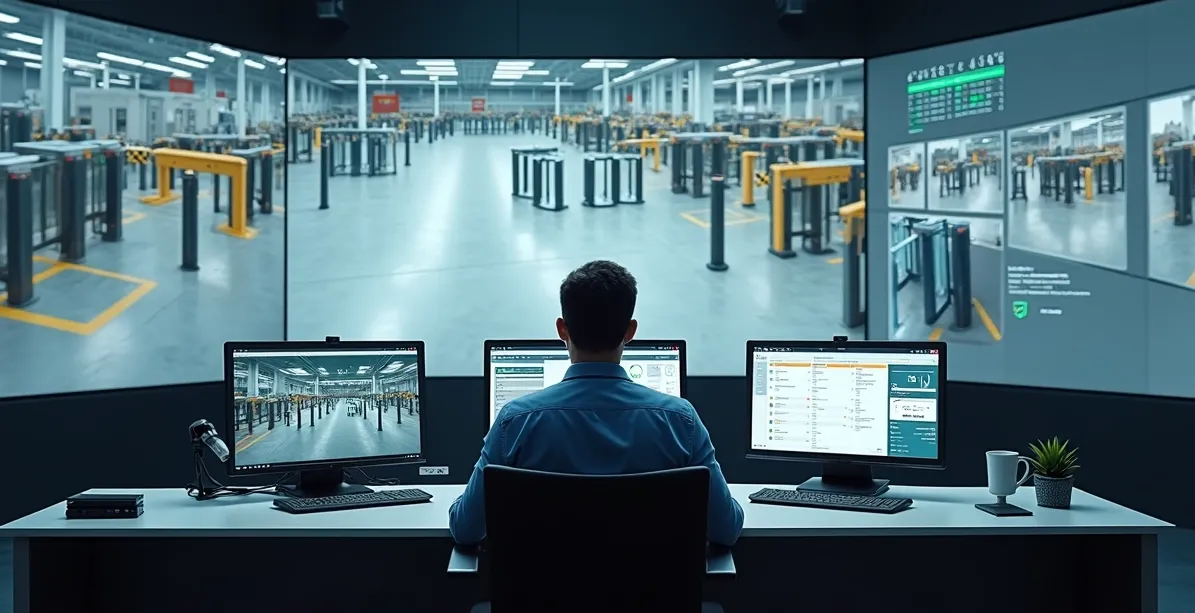
In today's corporate environment, third-party management has become a growing challenge for companies that deal daily with large volumes of outside people, such as service providers, suppliers and visitors.
As operational demands pile up, the risk of failure rises, and any incident can expose the organization to losses and serious legal penalties.
Manual processes, document checking and decentralized controls do not keep pace with industrial, logistics or corporate operations that see heavy circulation of people and vehicles.
Read on!
What are the main challenges of controlling third parties manually?
Large operations tend to feel the bottlenecks of manual administration early. Human error, slowness, conflicting information and difficulty standardizing processes are common examples.
- Entry of professionals with expired documentation;
- Difficulty controlling expiry dates and certificate updates;
- Excessive dependence on control through spreadsheets and email;
- Lack of integration with physical access systems;
- High costs from rework and teams dedicated solely to checking;
- Susceptibility to labor, tax and social security risk.
When management is decentralized, the company loses visibility over the compliance status of each contractor. The picture can be made worse by the high turnover typical of sectors such as construction, mining and logistics.
There is a limit to control through traditional processes. The flow only has to grow, or one breach to occur, for the model to call for more security and speed.
When do the warning signs appear?
Anyone following operational departments has already noticed: many practical signs point to the right moment to adopt more robust systems. The signs appear both in operations with dozens of contractors and in those with thousands of monthly access events.
- A growing volume of companies and professionals circulating;
- Repetition of manual tasks with no gain in scale;
- Delays in checking, leading to queues or halted activities;
- Difficulty ensuring only authorized people enter critical areas;
- Notification of incidents involving irregular access or invalid documentation;
- Recurring audits flagging document nonconformity or gaps in the chain of responsibility;
- Overloaded managers resolving questions about deadlines, status and authorizations;
- Rising operational cost just to keep the flow under control.
In that scenario, systems with artificial intelligence and automation come to be seen as strategic allies. Solutions such as RainbowTec are designed precisely to eliminate noise, centralize information and make the entry and exit cycle safer.
Automation and AI: how do they work in practice?
Using automation is not limited to digital registration or reading badges. The advantage lies in system integration: from receiving documents through to automatically releasing the turnstile.
When the whole clearance flow happens online, control becomes instant, and risk plummets. Artificial intelligence performs a detailed analysis of the documents each third party submits, detecting inconsistencies, validity dates and digital signatures.
With that, the manager receives automatic alerts about expiries, outstanding items and irregularities. Here are the main gains from combining automation, AI validation and integrated physical control:
- Elimination of manual checks and human error;
- Access control tied to document compliance in real time;
- A drastic reduction in the time to analyze and approve suppliers;
- Advanced reports for audits and risk indicators;
- Immediate access blocking in case of nonconformity;
- Integration with turnstiles, barriers, gates and other physical controls;
- Intuitive standardization, even when handling dozens of categories of contractor or visitor.
Automation solutions also reduce internal noise. The supplier can upload their own documents, track the approval status and meet new update requests without the contracting area losing time in back-and-forth emails.
Direct impact on security and compliance
Automating the flow means committing to the integrity of the operation. That is reflected in confidently blocking unauthorized access or automatically clearing those who are compliant in the system.
Visits, contractors and carriers are handled according to rules defined by the business, with traceability at each stage and a complete audit trail.
Experiences such as RainbowTec's show that integrating digital controls with physical barriers creates an environment shielded against improper access and drastically reduces unexpected occurrences.
Beyond security, automation also strengthens the compliance pillar. During internal and external audits, complete reports are accessible, documenting the whole cycle from clearance through to the record of entry and exit.
In environments where labor and tax legislation is strict, such as ports, chemical plants or data centers, that traceability is indispensable for avoiding fines and even shutdowns.
To broaden your understanding of the relationship between automation and security, it is worth looking into articles in the security category.
How to take the next step?
When you spot signs in your own routine such as growing volume, recurring documentation problems or failures in third-party entry, it is time to look for new solutions. The process can be started in stages, focusing first on the most vulnerable points, whether in document control or in integration with physical access.
Cloud solutions, such as RainbowTec's, bring constant updating, standardized processes and intelligent automation, without giving up customization for each type of operation.
Anyone wanting to go deeper into the benefits and technical detail can visit the automation and artificial intelligence categories on the company's blog.
Turning the control of third-party access and documentation from a recurring problem into a competitive advantage is possible. What separates insecure operations from efficient ones is the decision to automate. And it starts with recognizing the signs.
Automating the whole access flow in third-party management is a strategic choice for companies wanting to raise the level of security, standardize processes and eliminate the risk of nonconformity.
Organizations that feel the weight of manual control in practice, the slowness of approvals and the uncertainty about the integrity of data already have clear signs that it is time to change.
RainbowTec's purpose is to support businesses that depend on the entry of third parties, suppliers and visitors with innovative technology solutions. Explore every possibility on our site.
Frequently asked questions
What is automated third-party management?
Automated third-party management is the use of digital systems to control and validate, in real time, the access of contractors, suppliers and visitors, integrating document validation with physical controls. That includes process automation, document analysis by AI, detailed records and integration with turnstiles and barriers.
When should I automate third-party access?
The recommendation is to automate when you see growth in contractor volume, frequent checking failures, difficulty controlling expiry dates or incidents of improper access. Common signs are constant rework, queues at the gate and notifications of nonconformity.
What are the benefits of automation in this process?
Automation ensures fewer errors, speeds up clearances, offers automatic irregularity alerts and cuts the time spent on bureaucracy. It also reinforces security and generates detailed reports for auditing, while increasing the confidence of everyone involved in the process.
How do you choose the best automated system?
Assess whether the system offers complete integration (document control plus physical access), intelligent validation, traceability and constant updating. Favor cloud platforms that are easy to use, such as RainbowTec, and that suit the reality of your segment.
Is automating third-party access worth it?
Yes. Automation reduces legal risk, raises the level of security and frees the team for more strategic activities. The return shows up in shorter waiting times, a low incident rate and resource savings in the medium term.