
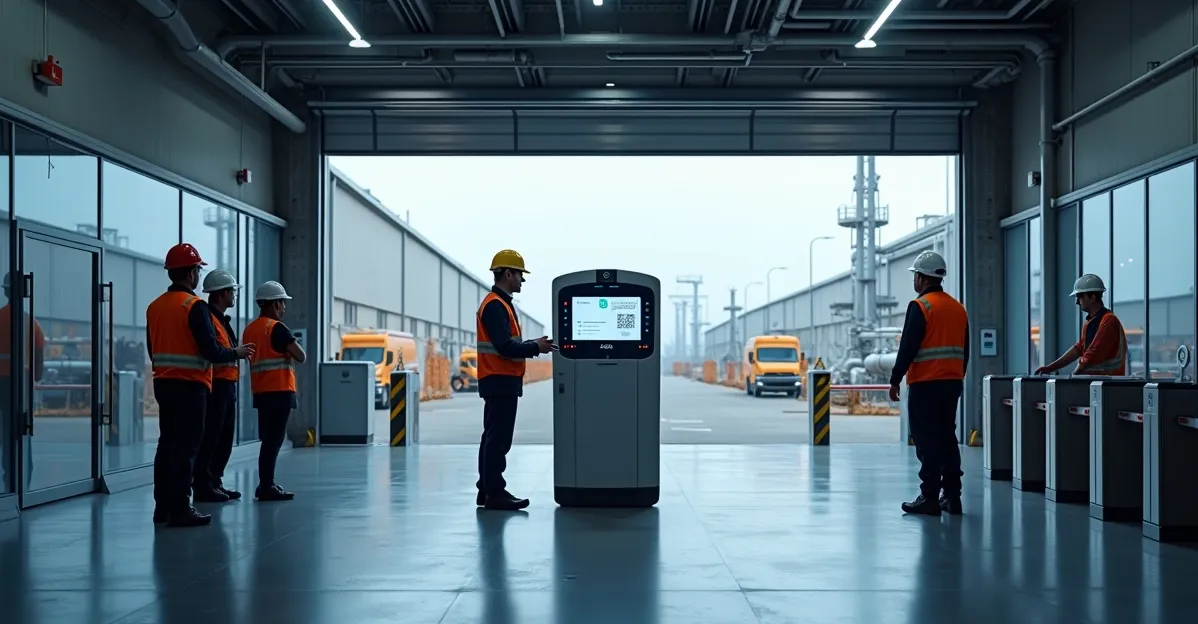
In the context of large industrial operations, self-service at gatehouses has become an increasingly adopted practice for speeding up the flow of people, vehicles and service providers.
Although that model brings benefits in convenience, it can also expose companies to risks affecting physical security, the integrity of processes and legal compliance.
Read on and learn more!
What changes with self-service at industrial gatehouses?
The arrival of self-service revolutionized the gatehouse routine, allowing employees, contractors and visitors to register and validate credentials independently. That reduces dependence on human operators and brings speed to the process.
Control, previously exclusively manual, evolved into a digital environment where automated integrations and cross-referencing of data are the rule. Vulnerabilities, however, come along with that convenience.
Self-service devices, automatic reading systems and digital document validation create new challenges when it comes to information security and access compliance.
What are the main technical failures and their impact on access?
Technical failures are frequently cited as the main risks of self-service at industrial gatehouses. A simple power outage or connection interruption can compromise access control for minutes, or even hours.
- Systems that are down prevent identification and the recording of entry and exit.
- Card, biometric or QR code readers can fail, creating a need for manual intervention.
- Physical equipment (turnstiles, barriers) depends entirely on the central system working well.
In emergencies, the absence of technological redundancy complicates matters further. At those moments, response time is precious. A failure can cause long queues or, worse still, allow unrecorded entries through misalignment between systems.
Weaknesses in identity validation: risks to integrity
In self-service, identity validation depends on automated systems and often on rules configured for reading documents and biometrics. Small failures are enough: an expired document not identified, an imprecise biometric reading or a wrongly captured image, for a serious risk to take hold.
The main scenarios of concern are:
- Borrowed or duplicated credentials, making it possible for one person to use another's data to access restricted areas.
- Fraud in digital documents, such as manipulation of images and electronic data.
- Biometrics registered incorrectly, leading to improper release of access.
User training, automated alerts and updating the databases are strategies specialists recommend to minimize such risks.
The vulnerability of documents: how small gaps become big problems
One of the pillars of self-service is the digital submission and validation of documents. But if the system lacks robust mechanisms for automatic analysis, or fails to identify that certificates and authorizations are out of date, the risk grows.
- Expired documentation can go unnoticed.
- Poor-quality or digitally altered files make verification harder.
- The absence of integration with public systems prevents automatic checking of compliance.
For that reason, tools equipped with artificial intelligence are already seen as allies in checking and recognizing authenticity, mitigating fraud in the entry of third parties into critical areas in third-party management.
Unauthorized access and exposure to physical risk
When the self-service process is not well tuned, exposure to unauthorized access becomes real. That can happen both through system failures and through improper manipulation of registered information.
- Visitors without clearance manage to enter administrative or production areas.
- Service providers move around without proper supervision, increasing asset protection risks.
- Recently departed employees keep active credentials through inattention or delays in updates.
Beyond that, video monitoring systems and alarms for anomalous behavior are complementary, making the environment safer.
Legal risk and liability
Self-service automates the registration of information and the submission of labor, social security and tax documents. If validating that data does not happen correctly, the contracted company can be held liable in the event of audits and lawsuits.
Among the risks identified, the following stand out:
- Entry of workers without proper labor registration, or contractors with outstanding documents.
- Access records not updated, making internal investigations and compliance with standards harder.
- Absence of digital evidence, compromising defenses in legal proceedings.
To avoid these implications, specialists reinforce the need for:
- Periodic audits of access and records.
- Integration with internal HR and compliance systems.
- Implementation of electronic audit trails.
Those precautions are reinforced in discussions about corporate security and best practice for compliance.
The impact of integration with internal systems
It is common for companies to try connecting self-service to systems they already have: payroll, HR, security systems and visitor control. But when the integration is not done well, risks arise, such as outdated data or loss of synchronization of authorizations.
- Delays in revoking credentials compromise control.
- Redundant processes increase the chance of manual error.
- Isolated systems make traceability harder in the event of incidents.
In that context, attentive companies adjust routines and keep integration aligned with technology updates, following trends in access control and operational automation as a reference for greater security.
Third-party management: the fine line between security and exposure
Contractors are part of the routine of any industry or large operation. Self-service requires all documentation and access clearance to be in perfect order. When management falls short, the risks grow:
- Contractors' out-of-date documents are not detected in time.
- Irregular hiring goes unnoticed in quick audits.
- Tracking of labor and tax expiry dates is neglected.
Technology updating: the need to keep pace
Technology at industrial gatehouses evolves quickly. Old or unmaintained systems lose effectiveness in both performance and security. If updating is not constant, new threats appear, such as digital attacks, incompatibility with new equipment and gaps in integrations.
That is why companies that value security and compliance invest in regular code reviews, team training and periodic replacement of the most vulnerable components.
Self-service at industrial gatehouses offers convenience, but it also amplifies risk when it is not implemented with continuous monitoring, constant updating and clear policies on identification and document validation.
The threats range from technical failures that interrupt operations to errors that expose companies to unauthorized access and legal proceedings. Keeping self-service secure depends on synergy between up-to-date technology, system integration, efficient third-party management and rigorous access controls.
Follow our social media channels for more content on security, third-party management and trends in access control. We are on LinkedIn!
Frequently asked questions
What is self-service at gatehouses?
Self-service at gatehouses is the process where employees, visitors and contractors carry out their own entry registration, document validation and access clearance, normally through electronic terminals or online platforms, without the need for direct intervention by a human operator.
What risks can self-service bring?
Among the main risks are technical failures in the equipment, weak identity validation, the possibility of unauthorized people entering, use of expired or altered documents and problems integrating with internal systems, increasing exposure to legal and security problems.
How do you increase security in self-service?
To increase security, it is advisable to adopt constant system updating, automatic and cross-referenced validation of information and direct integration with monitoring resources, such as cameras and alarms. It is also advisable to run periodic audits and train users in the proper use of the tools.
Is self-service worth using at the gatehouse?
Yes, when well implemented, self-service speeds up flows and reduces repetitive activities. It should, however, be accompanied by strict security measures, attentive monitoring and technology updating to offset the risks involved.
What precautions should be taken in self-service?
Specialists advise planning validation routines, integrating the gatehouse with internal systems, carrying out constant maintenance, delivering training and monitoring compliance and security indicators. That way, self-service can bring benefits without compromising operational integrity.