
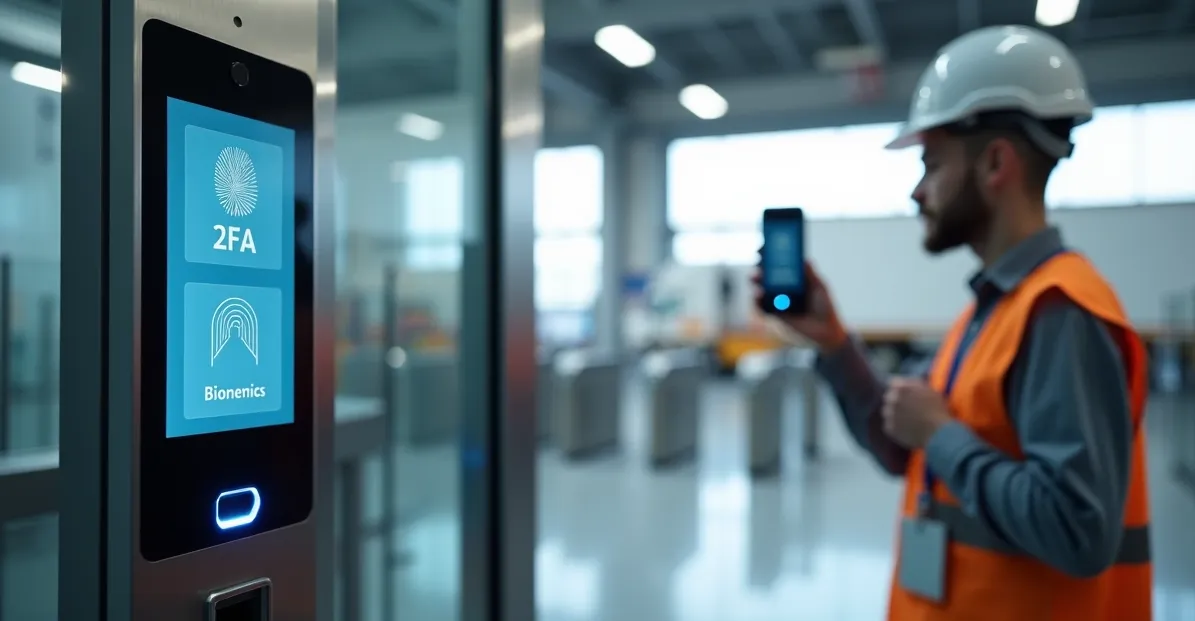
Two-factor authentication and biometrics have been establishing themselves as pillars of secure access control in industrial and logistics operations and in large corporate environments. After all, protecting employees, contractors, visitors and vehicles goes beyond simple locks or badges: it requires dynamic, integrated approaches that ensure security, compliance and traceability.
In that scenario, a common question arises: opt for two-step authentication or invest in biometric methods? Each technology has its strengths and limitations, particularly where the challenge is controlling intense flows of people and vehicles without compromising processes or creating excessive barriers.
With that in mind, this article covers how these two solutions work in practice, what they offer and how they can be combined for even more robust results!
What is two-step authentication?
In the context of access control, two-step authentication refers to the combined use of two different factors to prove a person's identity or clear a vehicle for entry.
These factors normally involve something the person knows (a password or code), something they have (a token, card or smartphone) and, sometimes, something they are (biological characteristics, typically covered by biometrics).
The central purpose of this approach is to prevent someone accessing a space merely by knowing a piece of data or holding a simple physical object. A practical example: a worker tries to enter a restricted storeroom and needs both their access card and a temporary code received on their phone.
How do biometrics work?
Biometrics is the science that uses people's physical or behavioral characteristics to identify them uniquely and automatically. In industrial and corporate environments, the most common biometric systems include:
- Fingerprint reading
- Facial recognition
- Iris verification
- Voice recognition
A typical example is clearing turnstiles through the service provider's fingerprint. A touch of the finger, the access is recorded and, if the documents are up to date, entry is authorized instantly.
What are the main advantages of two-step authentication?
Using two identification factors is not limited to the digital world. On the factory floor or at the corporate gatehouse, multiple authentication:
- Makes fraud harder, since breaking one layer is not enough to grant access
- Allows active monitoring and reporting on suspicious access attempts
- Is easily adjustable: if one method is compromised (such as a manager's password), the other keeps the barrier
- Makes integration with internal compliance systems flexible, blocking access where documents are outstanding
Companies with a high flow of third parties and visitors see significant gains from adopting two-factor authentication because it significantly reduces the risk of intrusion through shared credentials.
What benefits do biometrics offer?
Biometric systems present clear advantages in environments with intense movement:
- They remove the need to carry cards, badges or keys
- They provide greater speed for recurring workers, making control points more fluid
- They reduce the risk of unauthorized access through lost objects
- They promote automatic, detailed records for audits and traceability
Beyond that, it is possible to program restrictions by shift, area and profile, ensuring that only fit people move through critical zones, such as laboratories or raw material stores.
Limitations and challenges of each method
No authentication system is immune to limitations. In the case of two-step verification, barriers can arise such as:
- The need for additional devices (phone, physical token) for every user
- Longer validation time at peak hours, with queues and delays
- Resistance from workers not used to digital technologies
Biometric controls, despite their speed, bring other points of attention:
- Sensitivity to environmental conditions, such as dirt, heat, humidity or the use of protective equipment (gloves, masks)
- Concerns about privacy and the protection of biometric data, requiring legal alignment
- The need for specific equipment, with costs involved in implementation and maintenance
An experience reported by security managers showed that during the pandemic, facial recognition outperformed fingerprint touch for being more hygienic and faster, while physical tokens saw low uptake.
Speed, convenience and integration in high-flow environments
Companies running medium and large operations look for a balance between security and fluidity. It is common to find hybrid systems, where biometrics replaces the “something you have” factor and integrates with the “something you know” factor, forming a double defense.
For example, access to sensitive areas can require the fingerprint and a personal PIN. Vehicles, meanwhile, may need the driver's QR code and a face scan to enter without affecting the logistics rhythm.
These environments also demand deep integration with internal databases, allowing automatic blocks for contractors in default, detailed audits and temporary clearance for expected visitors.
Privacy and compliance: points of attention
The discussion of which approach to adopt cannot ignore privacy policy. Biometric data, being sensitive, demands strict rules on storage and access, including the legal obligations imposed by Brazil's General Data Protection Law.
In the case of multi-factor authentication, protection can be extended with real-time monitoring and blocking measures, plus fast revocation of permissions in case of deviations or departures.
Which operational risks are involved?
Choosing only one method can open gaps. For example, relying strictly on passwords and cards can leave the system vulnerable to internal fraud or improper sharing.
On the other hand, depending only on biometrics can cause delays when readings fail, or in industries where protective equipment limits sensor effectiveness.
In B2B operations with frequent visitors, contractors and carriers, intelligent combinations avoid the losses caused by clearance without proper verification.
Integrating the methods, when well planned, reduces occurrences of unauthorized access while maintaining compliance with legal and contractual requirements.
In the world of corporate access control, the decision between two-factor authentication and biometrics depends on the context, the volume of access and compliance requirements. Combined adoption offers the best of both worlds: convenience, robustness against fraud and reduced operational risk for large companies.
Share this article on your social media to inform colleagues and partners about advanced practices in security and access management!
Frequently asked questions
What is two-factor authentication?
Two-factor authentication consists of using two distinct elements to validate a user's identity, increasing protection against unauthorized access attempts. It is an additional layer of security that can combine password and token, card and code, or even biometrics and a PIN.
How does biometric verification work?
The biometric verification system identifies unique physical characteristics, such as fingerprint, face, iris or voice, to grant access. It all happens automatically and the data is cross-referenced with database records, allowing real-time control and traceability.
What are the advantages of two-factor?
The main benefits of two-factor authentication include greater resistance to fraud, a lower risk of credential sharing, flexibility to combine multiple methods (such as biometrics or a token) and easy revocation in case of suspicion or departure.
Is two-factor safer than biometrics?
Multi-factor authentication, which can include biometrics, generally offers higher levels of security than using a single method on its own. The combination reduces vulnerability to targeted attacks or fraud.
When should you use two-factor authentication?
Two-factor authentication is recommended in critical locations and systems, restricted areas, operations with sensitive data, intense flows of people and contracts demanding high traceability. It is especially recommended where operational risk justifies an extra layer of defense.