
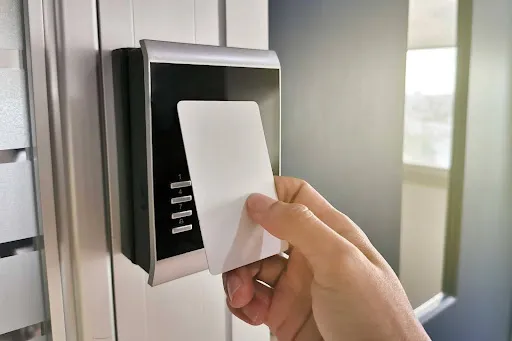
Access control is the set of rules, processes and technologies that defines who can enter each area of an operation, when and under what conditions. The types range from physical control, at turnstiles and barriers, to logical control, in systems and data, with credentials that include badges, passwords, biometrics and facial recognition. Implementing it requires mapping risks, defining permission profiles and integrating hardware and software into a single base.
In industrial operations, ports, logistics centres and major construction sites, knowing who is inside the plant right now has stopped being an administrative convenience. It is a requirement of security, of labour compliance and, increasingly, of client and insurer audits.
Access control is the layer that answers that question in real time. Implemented well, it prevents entry by anyone who is irregular, records every movement and turns the gatehouse into an automated decision point rather than a bottleneck.
In this guide you will understand the types of access control, why it is strategic and how to implement it step by step. Enjoy the read!
What is access control and why is it strategic?
Access control is the discipline that determines and enforces who may enter a given environment, at what time and with which credential. In practice it combines three elements: an identity (the person or vehicle), a credential (what proves that identity) and a permission rule (what that identity is allowed to do).
The difference between an ordinary gatehouse and mature access control lies in the rule. Without it, the guard decides by judgement. With it, the system decides by policy — and records the decision.
Access control is not the same as asset protection
They are complementary layers. Asset protection looks after the perimeter, surveillance and incident response. Access control looks after authorisation: it guarantees only qualified people cross each point. An operation with cameras and no access control sees the problem after it has happened.
What are the types of access control?
The first division is between the physical and the digital world.
Physical access control
It regulates entry into spaces: gatehouses, turnstiles, barriers, gates, doors to restricted areas and loading docks. It is what stops an untrained contractor entering a classified area, or an unauthorised vehicle reaching the yard.
Logical access control
It regulates entry into systems and data — logins, profiles, screen permissions and audit trails. It is what guarantees that only those whose role requires it can consult, for example, sensitive third-party data.
Types by credential
Within physical control, the most useful day-to-day classification is by the credential used:
Proximity badge or RFID card. Cheap and fast, but lendable. Suited to low-risk areas or combined with a second factor.
Password or PIN. Simple to deploy, but shareable. Rarely used alone in a corporate environment.
Biometrics. Fingerprint, palm or iris. It ties access to the person, not the object. See the advantages of combining two-factor and biometrics.
Facial recognition. Contactless, fast and hard to defeat. It is the option that best balances flow and security at high-volume gatehouses — see how facial recognition works in practice.
Licence plate reading (LPR). For vehicles, normally paired with driver identification.
Permission models
Beyond the credential, there is the logic that grants the right. The most used models are role-based (access follows from the job or function), attribute-based (it considers context, such as time of day, valid training and current documentation) and discretionary, in which a manager authorises case by case. Operations involving third parties tend to require the attribute model, because permission depends on conditions that change every day.
Why does access control matter?
It prevents access by anyone who is irregular. A contractor with an expired occupational health certificate, lapsed training or an outstanding document simply is not released. The rule applies to everyone, without depending on the guard's memory.
It reduces labour risk. The record of who entered, when and through which access point is documentary evidence in inspections and labour claims. Without that history, the company argues on the basis of hearsay.
It provides traceability. In the event of an incident, accident or deviation, the trail shows exactly who was in each area. It is the basis for analysing logs and identifying fraud.
It supports certification. Standards such as ISO 27001, ISO 45001 and ISO 14001 require evidence of control over who accesses areas and information.
How to implement access control in six steps
1. Map areas and risk levels
Not every area needs the same rigour. Classify environments by criticality — administrative, production, classified area, warehouse, data centre — and define the level of requirement for each.
2. Define profiles and permission rules
Write the policy before buying equipment. Who can enter where, at what time, with which prerequisite. That document becomes the company's access control policy.
3. Choose credentials by area
Balance cost and risk. Badge at the administrative entrance, facial or biometrics in critical areas, two-factor wherever the impact of improper access is high.
4. Integrate the prerequisites into the record
This is where most projects fail. If documentation, training and contracts live in separate spreadsheets, the turnstile cannot decide. Release has to consult a single, up-to-date base.
5. Deploy in stages and validate
Start with the highest-traffic access point, measure passage time and adjust before expanding. A gatehouse that jams creates pressure to bypass the rule.
6. Monitor and review
Track blocking indicators, denied attempts and release times. Review permissions whenever someone changes role or leaves the company.
How RainbowTec delivers end-to-end access control
RainbowTec is software only and works with the market's leading hardware manufacturers, including several of them at the same site. That preserves the investment already made in turnstiles, barriers and readers.
The differentiator is the integration: the access control module talks natively to third-party management. The result is that permission stops being static. If a contractor's document expires at 11:59 pm, their release drops the minute after — with nobody having to remember.
All of this with real-time monitoring, a complete audit trail and LGPD compliance, backed by Bureau Veritas ISO/IEC 27001 certification.
Mature access control is not what blocks entry: it is what guarantees that only those who are authorised, trained and compliant get in. Talk to RainbowTec and see how to apply this in your operation.